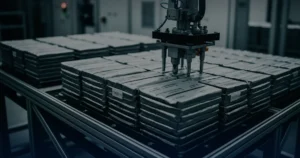
The global battery industry is undergoing its most significant period of technological diversification since the lithium-ion cell was commercialized in 1991. At least five distinct battery chemistries and architectures — solid-state, sodium-ion, lithium-sulfur, silicon-anode, and dry-electrode — are simultaneously moving from laboratory validation toward pilot production, creating a competitive landscape that could fundamentally reshape the cost, performance, and supply-chain dynamics of electric vehicles within the next three to five years.
The Contending Technologies
Solid-state batteries remain the highest-profile contender. By replacing the liquid electrolyte with a solid material, these cells can safely use lithium-metal anodes and achieve energy densities of 350–500 Wh/kg — up to double that of conventional lithium-ion cells. Toyota, Samsung SDI, CATL, and numerous Chinese startups have announced production timelines between 2026 and 2030, though manufacturing yield challenges persist.
Silicon-anode cells are a nearer-term opportunity. Companies including Sila Nanotechnologies, Group14 Technologies, and Amprius Technologies have developed silicon-dominant anodes that increase cell energy density by 20%–40% compared with graphite anodes while remaining compatible with existing liquid-electrolyte manufacturing lines. Mercedes-Benz began using Sila’s silicon-anode cells in the EQG in 2025, and Amprius is supplying cells with energy densities above 400 Wh/kg for aviation and defense applications.
Lithium-sulfur batteries offer a theoretical energy density of 2,600 Wh/kg — roughly ten times that of current lithium-ion cells — and use sulfur, one of the cheapest and most abundant industrial chemicals, as the cathode material. Lyten, a San Jose-based startup, has demonstrated a lithium-sulfur cell at 900 Wh/kg in prototype form and is targeting initial production for aerospace applications in 2026.
- Solid-state: 350–500 Wh/kg, 2026–2030 production timelines, sulfide/oxide/polymer electrolytes
- Silicon-anode: 300–450 Wh/kg, already in limited production, compatible with current manufacturing
- Lithium-sulfur: 400–900 Wh/kg demonstrated, cycle life remains the primary challenge
- Sodium-ion: 160–200 Wh/kg, lowest cost, best for entry-level EVs and grid storage
- Dry-electrode: Process innovation (not chemistry), reduces factory footprint and energy use by up to 50%
Dry-Electrode Manufacturing
Among the less-discussed but potentially most impactful developments is the dry-electrode process, in which cathode and anode coatings are applied to current collectors without the use of toxic NMP solvent and energy-intensive drying ovens. Tesla acquired the technique through its 2019 purchase of Maxwell Technologies and has been scaling it at its Austin, Texas gigafactory. CATL, LG Energy Solution, and Panasonic have all disclosed parallel dry-electrode R&D programs.
The appeal is primarily economic. Conventional electrode coating and drying accounts for 25%–30% of total cell manufacturing cost and 40% of factory energy consumption. Eliminating the drying step reduces cell production costs by $8–$12 per kWh, according to estimates from Argonne National Laboratory, while also shrinking the physical footprint of a gigafactory by approximately one-third.
“The next generation of EVs will not be defined by a single battery chemistry. It will be defined by the right chemistry for the right application — sodium-ion for city cars, silicon-anode NMC for premium sedans, solid-state for performance vehicles, and LFP with dry electrodes for everything in between.” — Dr. Venkat Srinivasan, director, Argonne Collaborative Center for Energy Storage Science
What It Means for the EV Market
The convergence of these technologies creates an environment in which no single chemistry will dominate. Instead, the battery industry is moving toward a portfolio approach, with different chemistries optimized for different price points, performance requirements, and geographic supply-chain realities.
For consumers, the practical implications are straightforward: EVs in the 2027–2030 timeframe will offer meaningfully longer range, faster charging, longer lifespans, and lower prices than today’s models. BloombergNEF projects that the average EV battery pack price will fall below $80/kWh by 2028, driven by the combined effect of manufacturing scale, process innovation, and chemistry diversification. At that price, electric vehicles reach cost parity with combustion vehicles across virtually every market segment — without subsidies.
The companies and countries that successfully navigate this transition — bringing next-generation cells from pilot lines to gigafactory-scale production with acceptable yields and costs — will define the competitive map of the global automotive industry for the next two decades.